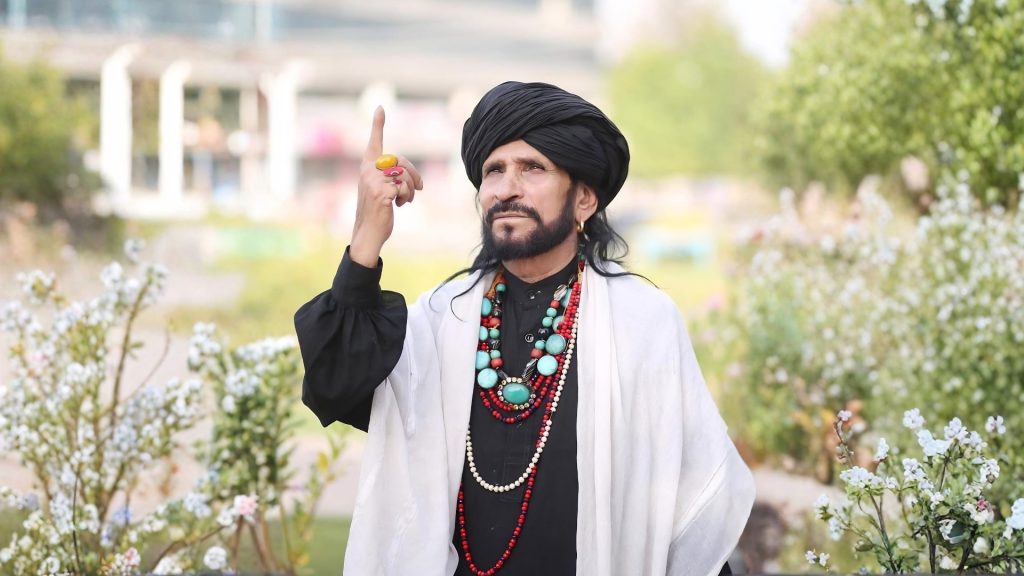
There are singers who perform music, and then there are those who become the music itself. Sain Zahoor belongs to the second kind. For over seven decades, he has carried the devotional poetry of Punjab’s greatest Sufi mystics through the dusty lanes of village shrines, across concert stages in London, Tokyo, and Oslo, and into the hearts of millions who may not understand a single word of Punjabi but find themselves moved to tears nonetheless. His voice does not just sing. It communicates something older than language, something that cuts through the noise of the modern world and reaches a place that very few artists ever touch.
If you are planning a cultural event, Sufi music festival, literary gathering, or a high-profile occasion where the presence of a genuine living legend would make the evening truly unforgettable, Sain Zahoor is a name that stands entirely in a category of its own.
A Life Born at the Shrine
Sain Zahoor was born in Sulaimanki, a village near Haveli Lakha in the Okara district of Punjab, Pakistan, as the youngest child in a rural peasant family. He is said to have started singing at the age of five, and from his earliest years, he was drawn toward the spiritual rather than the material world. As a young child, he experienced a recurring dream of a hand rising from a grave and calling him toward a Sufi shrine. That dream, which he has spoken of throughout his life, set the direction of everything that followed.
He left home at the age of ten and began a spiritual search that eventually led him to the ancient city of Uch Sharif in southern Punjab, a site of many Sufi shrines. There he found his first teacher, Ustad Sain Raunka Ali of the Patiala Gharana, who introduced him to the devotional Sufi kalams, the poetic verses that have defined his entire career. He also learned from musicians at Uch Sharif, deepening a musical education that was entirely oral and experiential, rooted in living tradition rather than any formal institution.
Although not formally literate, Zahoor is renowned for his extraordinary memory of song lyrics. He sings compositions of the great Sufi poets including Bulleh Shah, Shah Badakhshi, Muhammad Qadiri, Sultan Bahu, and others, carrying their words with a precision and emotional depth that comes from a lifetime of immersion rather than from any textbook.
Decades at the Dargah, Then the World
For much of his life, Sain Zahoor performed almost exclusively at dargahs, Sufi shrines, melas, and in the streets of Punjab. He was not a recording artist. He was not signed to a label. He was a wandering minstrel in the classical tradition, surviving through the generosity of those who gathered to hear him, moving from shrine to shrine with his tumbi in hand, dressed in his embroidered kurta, beads, tightly wound turban, and ghungroos on his ankles.
In 1989, Sain Zahoor performed on a concert stage for the first time at the prestigious All Pakistan Music Conference in Lahore. His performance enthralled an audience of around 2,000 people, leaving them in a state of deep emotional intensity through his delivery of Sufi verses.That concert marked the beginning of a shift from shrine-centric obscurity to broader public recognition. Pakistani television took notice, and his appearances on national broadcast channels introduced his unique voice to an urban audience that had never encountered anything quite like him.
BBC World Music Award and Global Recognition
The moment that introduced Sain Zahoor to the world came in 2006, not through a marketing campaign or a major label deal, but purely through word of mouth. He was nominated for the BBC World Music Awards in 2006 based entirely on grassroots acclaim, and he emerged as the Best Voice of the Year, an award that had earlier recognized Sufi legends Nusrat Fateh Ali Khan and Abida Parveen. For Sain Zahoor to share that company is a measure of how seriously the international music community regarded his contribution to Sufi traditions.
That same year, he released his debut album Awazay, meaning Sounds, through Matteela Records, giving global audiences their first proper recorded access to a voice that had been singing in shrines for over five decades. The album was received with widespread acclaim and opened the door to international touring that took him far beyond Pakistan.
His Coke Studio appearances further cemented his standing among younger Pakistani audiences. Songs like Allah Hoo, Aik Alif, Toomba, Rabba Ho, Nachna Painda Hai, and Lagi Bina introduced him to millions of viewers who connected instantly with the raw, earthy power of his voice set against contemporary musical arrangements. He has performed in Australia, Canada, Ireland, the UK, Japan, Norway, Dubai, Malaysia, Belgium, China, and India, making him one of the most widely traveled Pakistani folk artists of his generation.
His film work has also reached international screens. In 2007 he contributed to the soundtrack of Khuda Ke Liye, and in 2011 he sang the original soundtrack for West Is West, a British comedy-drama film. These contributions placed his voice in cinematic contexts that reached audiences across South Asia, the UK, and beyond.
Awards That Reflect a Lifetime of Service to Music
The recognition Sain Zahoor has received in the later years of his career reflects the scale of what he has given to Pakistani music and to Sufi traditions globally. He received the Pride of Performance Award from the President of Pakistan in 2020, the country’s highest honor in the arts, awarded for a body of work that spans nearly seven decades of devotional singing.
In 2022, Sain Zahoor was named a laureate of the Aga Khan Music Awards, an international honor recognizing outstanding achievements in music from and for Muslim societies. The award celebrated his lifelong commitment to preserving and performing Punjabi folk and Sufi traditions. The Aga Khan Music Awards place him among the most respected voices in Muslim cultural heritage on a global stage, in the company of artists from Mali, India, Afghanistan, and Iran.
Bollywood legend Amitabh Bachchan is among the admirers of Sain Zahoor, and met him personally during one of his visits to India, a testament to the cross-cultural reach of a voice that speaks in Punjabi but communicates in something universally human.
Why Sain Zahoor is the Right Choice for Your Event
Booking Sain Zahoor through Youzarsif Network means bringing a UNESCO-level cultural experience to your stage. His performances are not concert sets in the conventional sense. They are spiritual journeys. Audiences ranging from Pakistani music lovers to international cultural enthusiasts who have never attended a Sufi event before find themselves completely absorbed, often describing the experience as unlike anything they have attended in their lives.
He is ideally suited for cultural festivals, independence celebrations, literary festivals, interfaith gatherings, arts galas, and premium private events where the organizer wants to offer something rare, meaningful, and deeply rooted in Pakistan’s greatest artistic traditions.
At Youzarsif Network, we connect clients across Pakistan with verified, professional artists whose credentials and performance records are beyond question. Sain Zahoor represents the very highest level of what Pakistani music has to offer the world. Book him through our platform and give your audience a night they will carry with them for the rest of their lives.